
About Ashton
Driven by curiosity. Defined by precision. Committed to the craft.
An athlete who embraces the work, respects the long arc of improvement, and continues building with intent.
BUILT IN THE WORK. PROVEN IN THE AIR.
Ashton Salwan is a professional U.S. freestyle aerial athlete competing on the FIS World Cup circuit. In one of winter sport’s most technical and high-consequence disciplines, he has built his path through precision, discipline, resilience, and years of focused progression.
Raised in Cleveland, Ohio, Ashton’s path began with self-driven curiosity and evolved into a full commitment to high-performance sport. His development has been shaped by technical refinement, calculated progression, and the daily repetition required to compete at an elite international level.
Ashton's career reflects steady advancement through the North American and international pipeline, with a continued focus on increasing difficulty while protecting execution quality. In a sport judged in seconds, his performance is built through the unseen work: water ramps, strength training, air awareness, recovery, and constant refinement.
Off the hill, Ashton values professionalism, credibility, and authentic partnership. He shares competition highlights, training insight, and behind-the-scenes perspective that connect supporters to the real work behind elite sport.
“The jump happens in seconds. The standard behind it is built every day.” — Ashton Salwan
- DISCIPLINE : Freestyle Aerials Skiing
- PRIMARY CIRCUIT : FIS World Cup Tour
- OTHER COMPETITION EXPERIENCE : FIS NorAm Cup, Europa Cup, Junior World Championships and U.S. National Championships
- ATHLETE ROOTS : Northeast Ohio start → individual development pathway → international competition
- PROFESSIONAL INTERESTS : Partnerships aligned with performance, durability, and long-term athlete development
- Salwan Partnership Profile : Available for collaboration inquiries
OFFICIAL ATHLETE PROFILES
Ashton’s competitive career is documented across official federation, national team, recruiting, and professional platforms. Explore his biography, results, rankings, career highlights, and broader athlete background through the profiles below:
- Official Team USA Profile : Athlete biography, career highlights, and competitive background
- U.S. Ski & Snowboard Profile : National team biography, results, and competitive overview
- FIS Athlete Profile : International competition history, rankings, and results
- GMTM Athlete Profile : Recruiting profile and athletic background
- LinkedIn Profile : Professional network, experience, and athlete journey
ATHLETE MARKETING & PARTNERSHIP PROFILES
For media, partners, and collaborators, Ashton represents more than results alone. He is a disciplined, credible athlete building long-term value through professionalism, resilience, and performance built the right way.
As Ashton continues building his career in freestyle aerials, his marketing presence extends across a growing network of athlete, brand, and partnership platforms. These profiles support brand discovery, NIL opportunities, professional visibility, and meaningful connections with organizations aligned with Ashton’s journey.
- Team USA AMP Profile : USOPC athlete profile for NIL and brand opportunities
- Faves Storefront : Ashton’s favorite products, gear, and partner picks
- Opendorse Profile : Athlete marketing and brand discovery platform
- Hookit Profile : Athlete sponsorship and performance platform
- FreeAgent Profile : Verified private network of Elite Athletes






What were Ashton’s most recent season results?
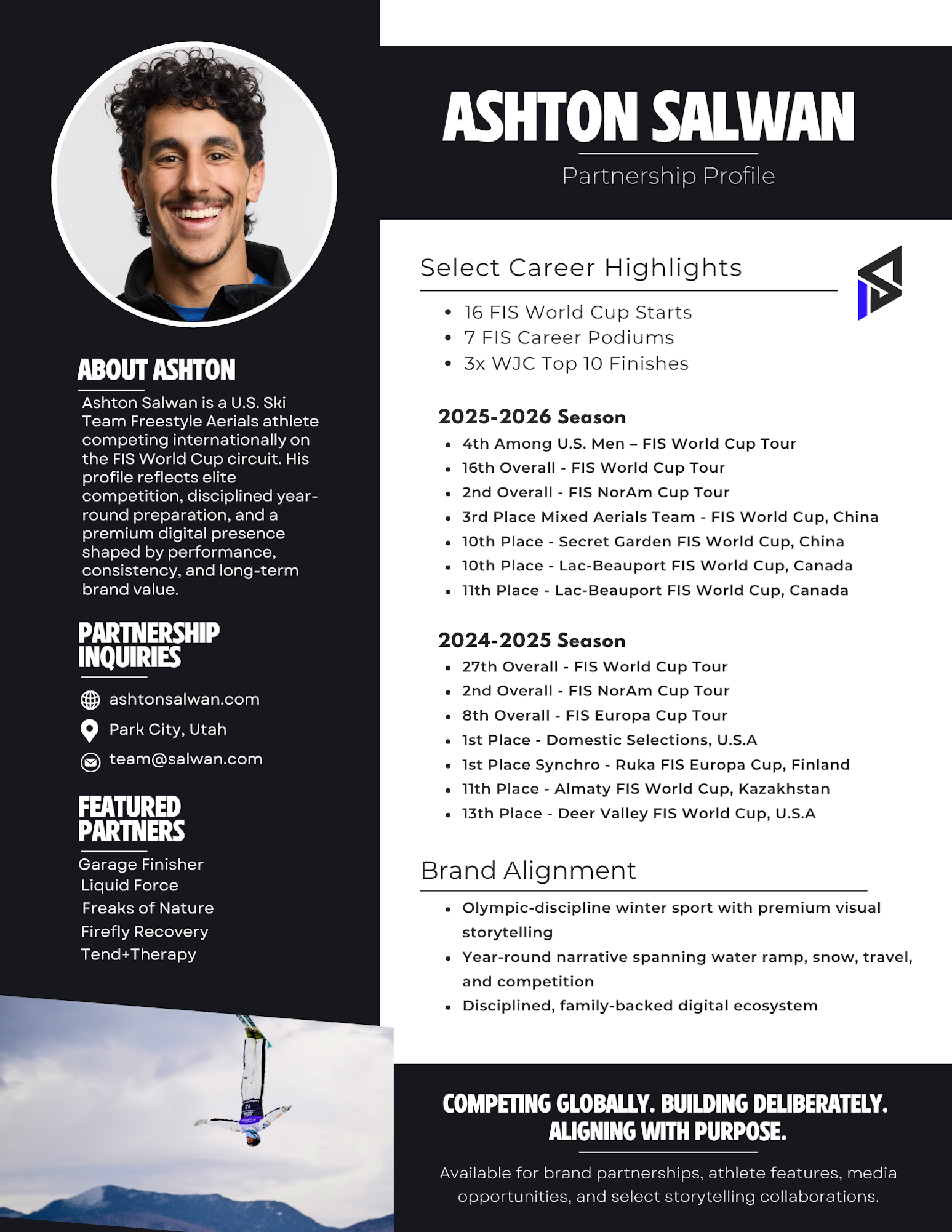
• 16th Overall — FIS Freestyle World Cup Aerials
• 10th — World Cup Secret Garden, CHN
• 10th — World Cup Lac-Beauport, CAN
• Bronze — Mixed Team Aerials, World Cup Secret Garden, CHN
• 2nd Overall — FIS Freestyle NorAm Cup Aerials
• 1st — NorAm Cup Lac-Beauport, CAN
• 3rd — FIS Freestyle Canadian Nationals Aerials
View full results → HERE
How can I follow Ashton’s journey and help?
The easiest way to help is to stay connected — follow, share, and support Ashton's evolution. In aerials, progress is built over years and in the quiet reps… then revealed in seconds.
Every share of Ashton's story helps amplify his work behind the results and keeps his journey moving forward.
What makes Freestyle Aerials different?
The sport of freestyle aerials skiing isn’t an actual race — it’s a judged performance under pressure. Speed is the runway to flight, but execution decides everything. Athletes have only a few seconds to convert approach speed into height, control, and a touchdown on snow that holds.
Then the jump’s degree of difficulty amplifies the result — which is why clean execution is everything. The hardest skills only matter when they’re done masterfully — and the margin between “great” and “almost” can be a single detail.
What does it take to become consistent in Freestyle Aerials?
Consistency in freestyle aerials skiing is built through repetition, but proven under pressure. Athletes must repeat precise takeoff timing, stay organized in the air, and land with control while adapting to changing speed, weather, and ramp conditions.
For Ashton, that means trusting the work, managing nerves, resetting quickly after mistakes, and staying committed to the process. In a sport decided in seconds, consistency is earned over years through discipline, repetition, and composure.
What does “triple” mean in Freestyle Aerials?
In freestyle aerials, “triple” can mean two related things. Most often, it refers to a triple flip — three flips, with twists layered in — one of the sport’s highest-risk, tightest-timing skills. At the elite level, triples can include multiple twists (even five twists total across the three flips in the hardest men’s variations).
“Triple” can also refer to the triple kicker (the largest of the three takeoff structures). The triple kicker is roughly 13.5 feet tall and can launch athletes about 45–50 feet into the air, creating the height needed for triple-flip combinations.
Either way, triples aren’t just “learned” — they’re earned through years of repetition until the takeoff, shape, and landing become reliable under pressure.
What does Freestyle Aerials training look like?
Training starts long before the competition lights and the scoreboard. Skills are developed on water ramps and reinforced on trampoline, then brought to snow — where weather conditions, speed, and the feel of the in/outrun demand real-time adjustments.
With strength, mobility, and recovery supporting impact-heavy landings, the season becomes a steady pursuit of small refinements that show up in big moments.
How is Freestyle Aerials scored?
Freestyle aerials scoring rewards the full package. Judges evaluate what they see:
• 20% air (takeoff height & distance)
• 50% form (body position & control)
• 30% landing (stability on impact)
• the jump’s degree of difficulty
Difficulty can raise the ceiling, but execution determines the score that counts on the day.
Where can I watch Ashton’s competition and training videos?
Ashton’s Film collection features selected competition highlights, training edits, season recaps, and athlete reflections. Together, the videos offer a closer look at the preparation, progression, and execution behind each season.
Visit the Film Page to explore the complete collection.
What equipment does Ashton use?
Ashton’s equipment setup varies between in-season on-snow training and competition and pre-season water ramping. Each product is selected for its performance, reliability, and suitability for the specific demands of elite freestyle aerials skiing.
ON-SNOW EQUIPMENT:
• Skis: KÄSTLE AerialX 160
• Ski boots: K2 Revolve Pro
• Helmet: PRO-TEC Classic Cert
• Eyewear: SMITH Ruckus
WATER-RAMP EQUIPMENT:
• Life vest: LIQUID FORCE HingeCGA
• Helmet: LIQUID FORCE Hero
• Wetsuit: AQUALUNG AquaFlex 3
• Skis: TISA Aerial 160
For additional gear, training products, recovery tools, and everyday favorites, visit Ashton’s Faves page.
Equipment listed reflects Ashton’s current training and competition setup. Product mentions do not necessarily indicate sponsorship, endorsement, or affiliate relationship.
How can brands work with Ashton Salwan?
Partnership inquiries are welcome, especially with brands aligned with performance, discipline, and long-term development. For a concise overview of Ashton’s athletic profile, competition experience, and platform, you can view/download the partnership one-sheet below.
If there’s a potential fit, use the CONTACT page to share a brief note about your brand and the type of partnership you’re exploring, and we’ll follow up with next steps.